I – Overview
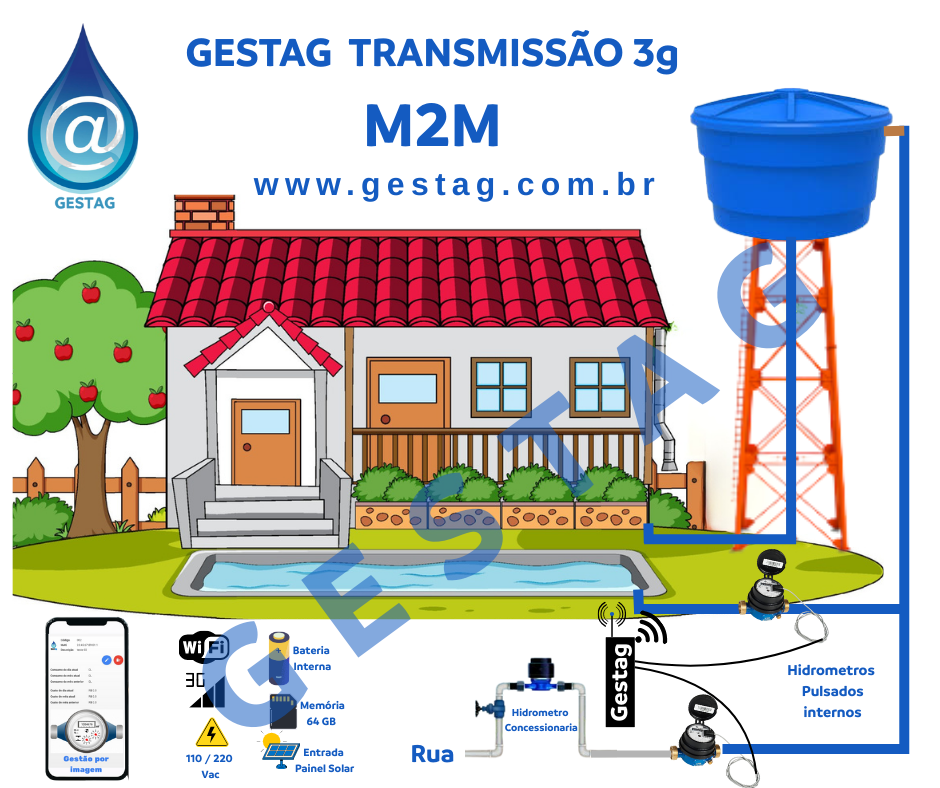
GESTAG is a water telemetry system composed of field units
connected to pulse water meters and a web management
platform. Each unit records flow pulses and transmits this
data via the cellular network (3G/M2M or Wi-Fi) to the
central system.
The architecture is modular: you can start with a few
points and expand as the project grows, without major civil
works or complex cabling.
II – Components & functions
-
GESTAG unit: electronic module
responsible for counting meter pulses, temporarily
storing data, and transmitting it over the cellular
network.
-
Pulse water meter: water meter with a
pulse output proportional to the measured volume.
-
Power/battery: power supply for the unit,
sized for high autonomy.
-
Management platform: web environment
where data is consolidated, displayed in dashboards, and
exported into reports.
III – Signal wiring topology
Each GESTAG unit is connected to the pulse contact of the
water meter using low-voltage cables. Wiring must follow
the meter manufacturer’s instructions and respect polarity,
shielding, and maximum recommended distances.
In larger projects, it is possible to organize interconnection
panels and separate conduits for instrumentation signals,
avoiding interference with power cables.
IV – Data flows & calculations
For each registered pulse, GESTAG updates the consumed
volume internally. Periodically, this data is transmitted
to the central system, which converts pulses into m³ or
liters and aggregates by minute, hour, day, month and other
configurable periods.
From the consolidated base, consumption charts, comparisons
by unit, alarms and automated reports are generated.
V – Installation best practices
- Plan the positioning of modules and antennas.
- Ensure easy access to points for future maintenance.
-
Protect wiring against moisture, excessive heat and
mechanical damage.
-
Clearly identify each meter and its corresponding monitored
point.
VI – Bill of Materials
A typical materials list includes GESTAG units, pulse water
meters, signal cables, power supplies, conduits, junction
boxes and mounting hardware. Exact sizing depends on the
number of points and the project’s hydraulic layout.